The Cons of Reverse Osmosis Water Systems: What Homeowners Should Know Before Choosing RO
Water · 9 min read
Summary
Article
Reverse osmosis sounds like the ultimate answer to drinking water.
It has a technical name. It is often sold as a premium under-sink system. It can reduce many substances when the right system is selected, installed, and maintained. For certain drinking-water goals, reverse osmosis can be useful.
But RO is not automatically the best water solution for every home.
In fact, many homeowners only hear the upside: "very filtered water." They do not always hear the tradeoffs: water waste, slower output, maintenance, storage tanks, mineral removal, taste changes, and the fact that an under-sink RO system does not solve whole-home water concerns.
Before choosing reverse osmosis, it is worth asking a better question: what problem are you actually trying to solve?
First, What Reverse Osmosis Does Well
Reverse osmosis is a point-of-use treatment technology that pushes water through a very fine membrane. The CDC explains that RO systems reverse the natural flow of water by pushing it from a solution with more substances through a filter toward a solution with fewer substances.
RO can reduce many things, depending on the specific system and its claims. CDC notes that reverse osmosis removes parasites, bacteria, and viruses, and can remove or reduce some chemicals including lead, copper, chromium, chloride, sodium, arsenic, fluoride, radium, sulfate, calcium, magnesium, potassium, nitrate, and phosphorus.
That sounds impressive, and it can be. But the words "depending on the system" matter. Homeowners should always check the system label, certification, maintenance requirements, and whether RO matches the actual water concern.
Con 1: Reverse Osmosis Wastes Water
The biggest practical downside of RO is water waste.
Reverse osmosis does not turn every gallon entering the system into drinking water. Some water becomes product water, and some becomes reject water that carries concentrated dissolved substances away from the membrane.
EPA's WaterSense program is direct about this tradeoff. Because RO is water-intensive, EPA says it does not intend to promote RO for all applications or encourage RO over treatment technologies that do not waste as much water.
That does not mean RO is never appropriate. It means water waste belongs in the decision. If your goal can be met by a less wasteful filtration option, RO may not be the best first choice.
Con 2: RO Is Usually a Drinking-Water Solution, Not a Whole-Home Solution
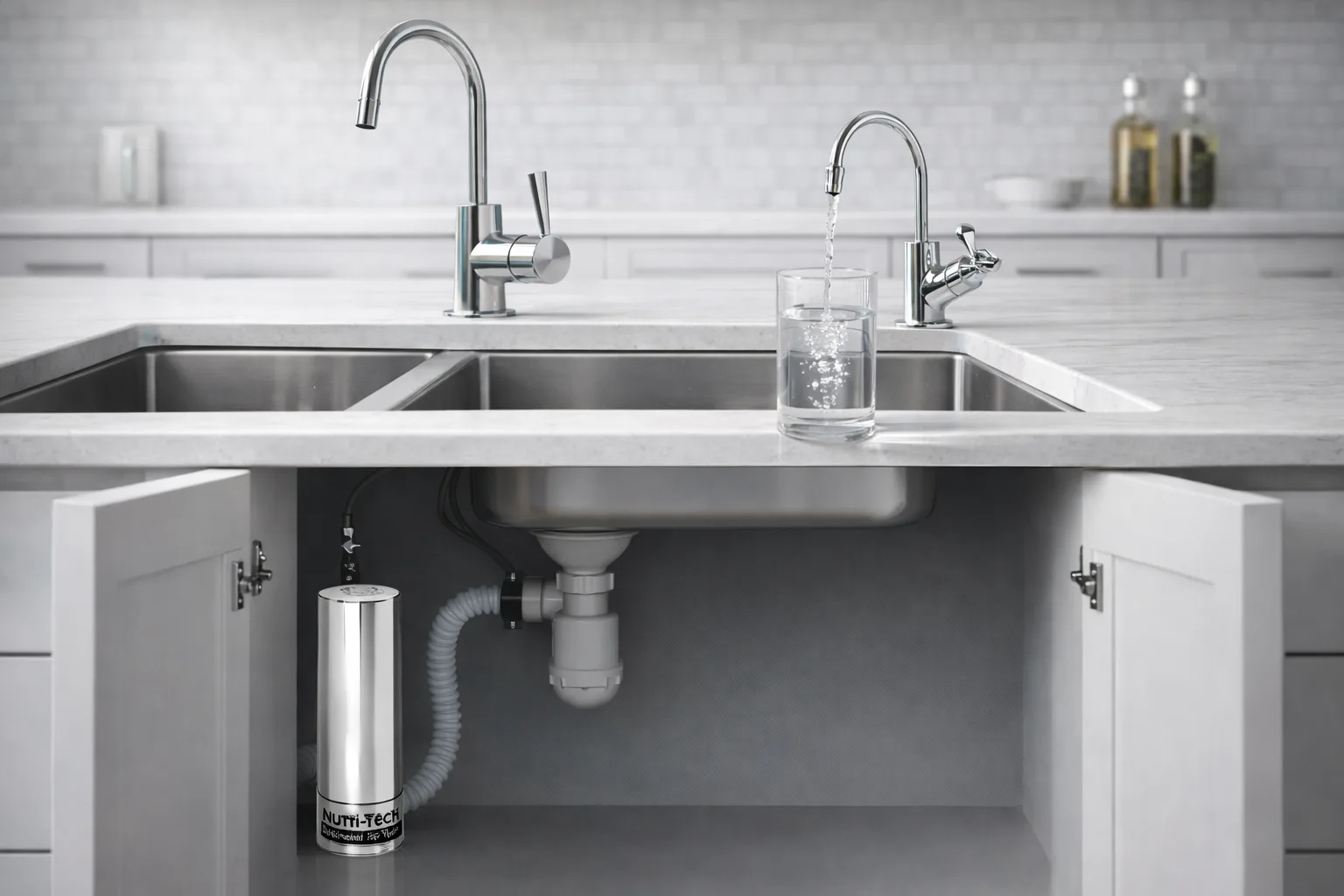
Most residential RO systems are installed under the sink or at a dedicated drinking-water tap. That means they treat water at one location.
That can be helpful if your main goal is drinking, cooking, coffee, tea, ice, or bottle filling.
But it will not fix water symptoms throughout the home.
RO at the kitchen sink will not usually address:
- shower feel
- hard-water scale on fixtures
- laundry concerns
- appliance buildup
- water spots on shower glass
- water quality at bathroom sinks
- whole-home chlorine or odor concerns
If your water concerns show up in multiple rooms, a point-of-use RO system may be too narrow.
Con 3: RO Can Be Slower and Needs Storage
Reverse osmosis systems often produce filtered water more slowly than a standard faucet. That is why many under-sink systems use a storage tank.
For some households, that is fine. For others, it can be annoying.
You may notice:
- limited water volume before the tank refills
- slower recovery after heavy use
- more under-sink space taken up by the tank and filters
- extra parts to maintain over time
This is not a dealbreaker for everyone, but it is a real usability issue. A system that looks great on paper still has to fit the way your household uses water.
Con 4: RO Requires Maintenance
No water treatment system is "set it and forget it."
Reverse osmosis systems require filter changes, membrane replacement, tank care, and sanitation according to the manufacturer's instructions. If maintenance is ignored, performance can drop and the system may no longer do what the homeowner assumes it is doing.
The CDC's general home water treatment advice is simple: test your water, choose a system that addresses your concern, and check the treatment system label for what it removes. That logic also applies after installation. A system only helps when it is maintained and used correctly.
Con 5: RO Removes Minerals Along With Other Substances
Reverse osmosis can reduce dissolved minerals, including calcium and magnesium. That can be a benefit when the goal is reducing certain dissolved substances. But it can also change the taste and feel of the water.
Some people like RO water. Some describe it as flat. Some systems add a remineralization stage for taste.
The main point is not that mineral reduction is automatically bad. The point is that it is a tradeoff. If your main concern is taste, you should sample or at least understand the type of water experience RO creates before assuming you will like it.
Con 6: RO May Be More Treatment Than You Need
Minnesota Department of Health guidance on home water treatment encourages homeowners to think about whether treatment is actually needed, what the target concern is, maintenance costs, and whether they want to treat one tap or the whole home.
That is the right mindset.
If your main concern is chlorine taste at the sink, RO might be more than you need. If your main concern is scale throughout the house, RO at one tap is not solving the real problem. If your city water report looks good and your only complaint is taste, a different point-of-use filtration option may be a better fit.
RO should be chosen because it matches the goal, not because it sounds like the strongest option.
Con 7: RO Can Distract From Whole-House Symptoms
This is the issue we see often: a homeowner starts with drinking water because that is the easiest symptom to name. But the real frustration is bigger.
They also have:
- spots on fixtures
- shower glass that will not stay clear
- dry-feeling showers
- appliance buildup
- laundry concerns
- odor or chlorine smell outside the kitchen
In that case, RO may improve water at the drinking tap while leaving most of the home unchanged.
That does not make RO bad. It means it was solving the smaller problem first.
When Reverse Osmosis Can Still Make Sense
RO may be worth considering when:
- the main goal is drinking and cooking water
- the system is certified for the substances you care about
- you understand the maintenance schedule
- you are comfortable with the water waste
- you have room for the system and tank
- you do not expect it to solve whole-home symptoms
It can also be part of a layered plan: whole-house treatment for broader home-water concerns plus point-of-use treatment for drinking water.
A Better Decision Framework
Before choosing RO, ask:
- Is my concern mainly drinking water or the whole home?
- What does my city water report say?
- What symptoms am I noticing at showers, fixtures, laundry, and appliances?
- Do I care about water waste?
- Am I willing to maintain filters and membranes on schedule?
- Do I want ultra-low dissolved solids, or do I prefer a different taste profile?
- Is there a simpler filtration option that solves my actual concern?
If those questions point mostly to the kitchen tap, RO may be on the table. If they point to the entire home, start with a broader water consultation.
Conclusion
Reverse osmosis can be useful, but it is not a universal answer.
The biggest cons of RO are water waste, maintenance, slower production, storage needs, mineral removal, taste changes, and narrow point-of-use scope. For some homes, those tradeoffs are acceptable. For others, a different filtration strategy makes more sense.
Pure Home Wellness helps homeowners compare the options with clear context. If you are trying to decide between reverse osmosis, point-of-use filtration, whole-house filtration, or a phased plan, start with your water symptoms and your goals before choosing the system.
Want Help Choosing the Right Water Path?
Pure Home Wellness can help you compare whole-house filtration, point-of-use filtration, and phased water planning in plain language.